
Performance & Materials
Cycling Jersey Fabric — Beyond the Spec Sheet
How performance materials behave under effort, heat, and time.
Performance in cycling is often measured in watts, seconds, gradients. Rarely in fabric.
And yet, the material closest to the skin shapes how the body handles effort, heat, and time. A cycling jersey fabric is not just a layer. It is an interface between rider and environment — the surface where physical work meets atmospheric resistance.
Most jerseys feel acceptable in the first twenty minutes. That is not where performance is decided.
01The First Touch Is Misleading
A cycling jersey fabric reveals itself slowly. The hand-feel in a showroom or out of the package tells almost nothing about how the material will perform on a ride.
Soft to the touch does not mean stable under stretch. Lightweight does not mean breathable. A jersey that drapes well on a hanger may collapse on the body once heat and movement enter the equation.
The first hour is generous. Most fabrics — even mediocre ones — feel fine. The body is still cool, the muscles still fresh, the sweat still minimal. Differences emerge later, when conditions sharpen.
This is why fabric quality is hard to evaluate in a store. The real test starts when the ride starts.
02What a Technical Fabric Actually Does
A cycling jersey fabric performs four functions at once, and the relationship between them defines quality.
First, thermal regulation. The fabric must allow excess body heat to escape without sacrificing structure. A material that traps warmth at intensity drains energy through a process the rider rarely notices — a slow accumulation of fatigue tied to micro-climate instability against the skin.
Second, moisture management. Sweat is constant. A high-grade moisture-wicking fabric moves water outward, where evaporation can occur — though research suggests the benefit is most measurable under specific conditions of heat and effort. Low-grade materials hold it close, growing heavier as the ride extends.

Third, dimensional stability. The fabric must stretch under effort and return to shape. It must hold its cut after one wash, after twenty washes, after a season of repeated use. Recovery is the property that separates jerseys that age well from those that do not.
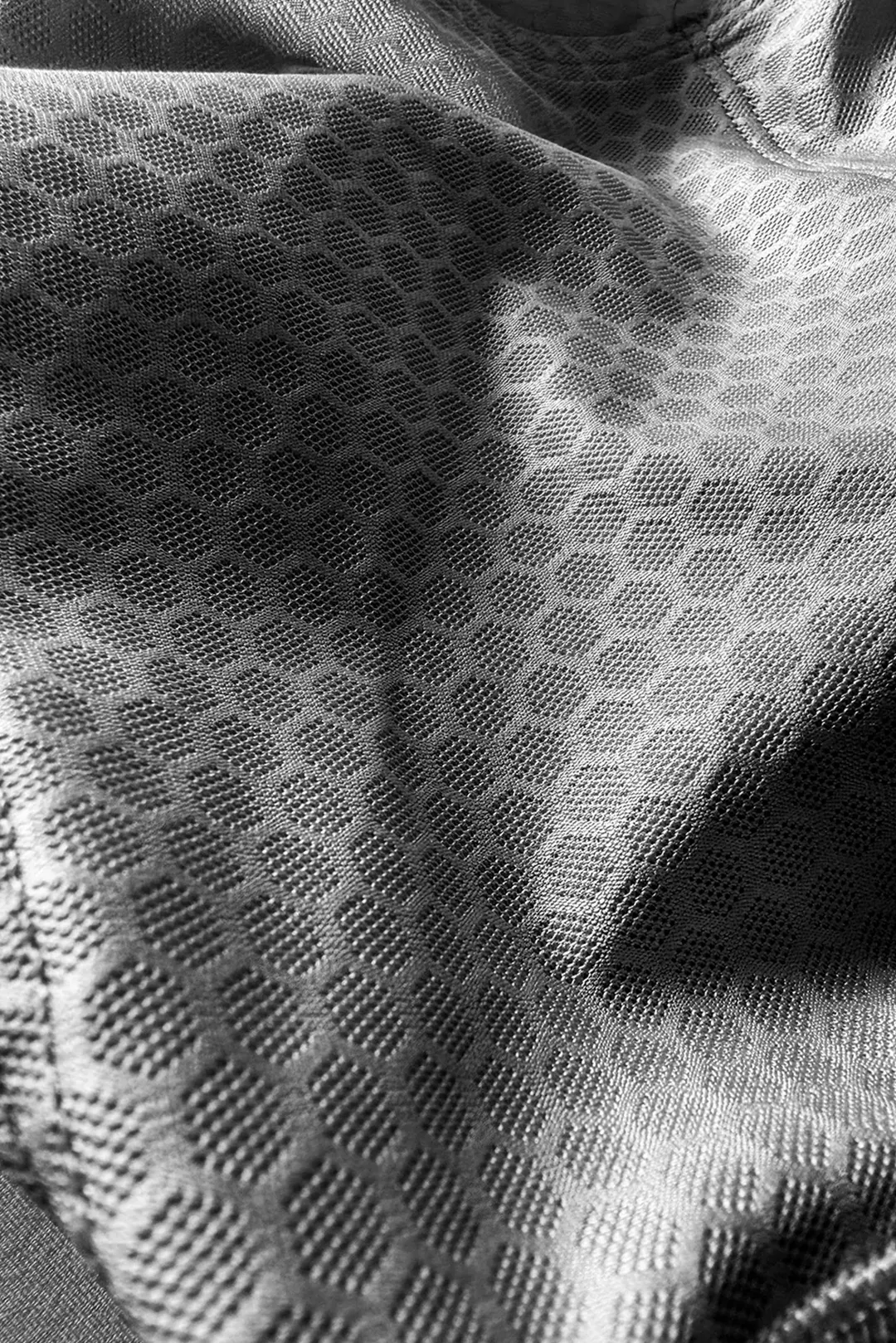
Fourth, surface behavior. At higher speeds, the relationship between fabric and airflow becomes part of the performance equation. Smooth surfaces, structured surfaces, three-dimensional surfaces — each interacts with air differently. This is the territory where aerodynamic cycling apparel is engineered.
A fabric that handles all four functions in balance is a performance fabric. One that handles only two or three is something else.
03Weight Is a Misleading Indicator
Riders often judge cycling jersey fabric by weight. Lighter must mean better. Lighter must mean faster.
It does not.
A lightweight fabric without structural integrity will lose its cut by the second hour. It will stretch under load and fail to recover. It will manage moisture poorly because density — within limits — supports moisture transport, not opposes it.
The right metric is not weight in isolation. It is weight in relation to function. Three hundred grams of well-engineered fabric can outperform two hundred grams of generic material across every parameter that matters: regulation, moisture, recovery, surface behavior.
The cycling jersey fabric that performs is the one calibrated to the riding intent — not the one that registers the lowest number on a scale.
04Mapped, Not Uniform
The highest-quality cycling jerseys do not use one fabric. They use several, mapped to where the body needs them.
A single uniform material treats the entire torso the same way. But the torso is not uniform. The chest sweats more than the sides. The lower back compresses against the riding position. The shoulders carry the most aerodynamic exposure. Each zone has different thermal, moisture, and structural needs.
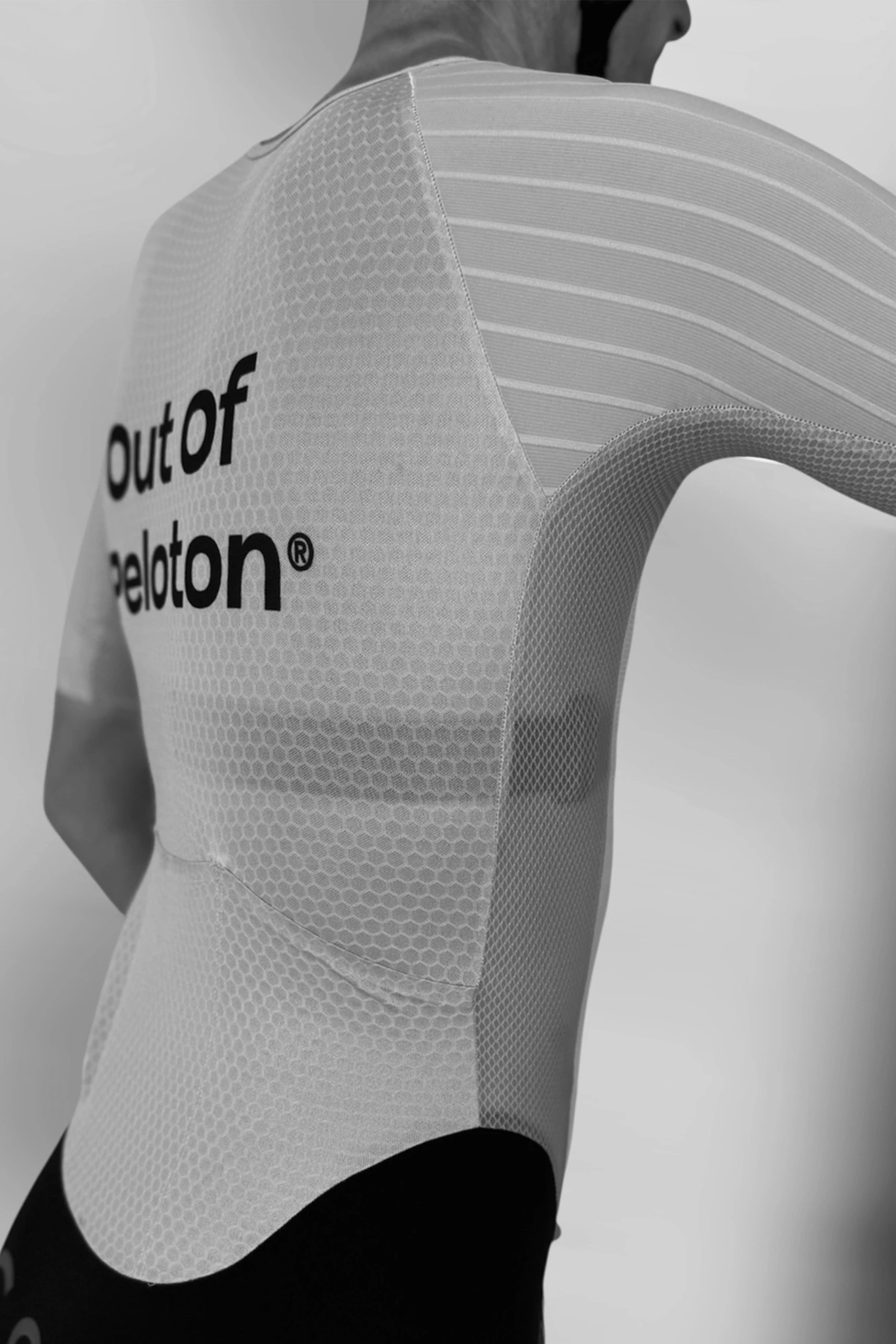
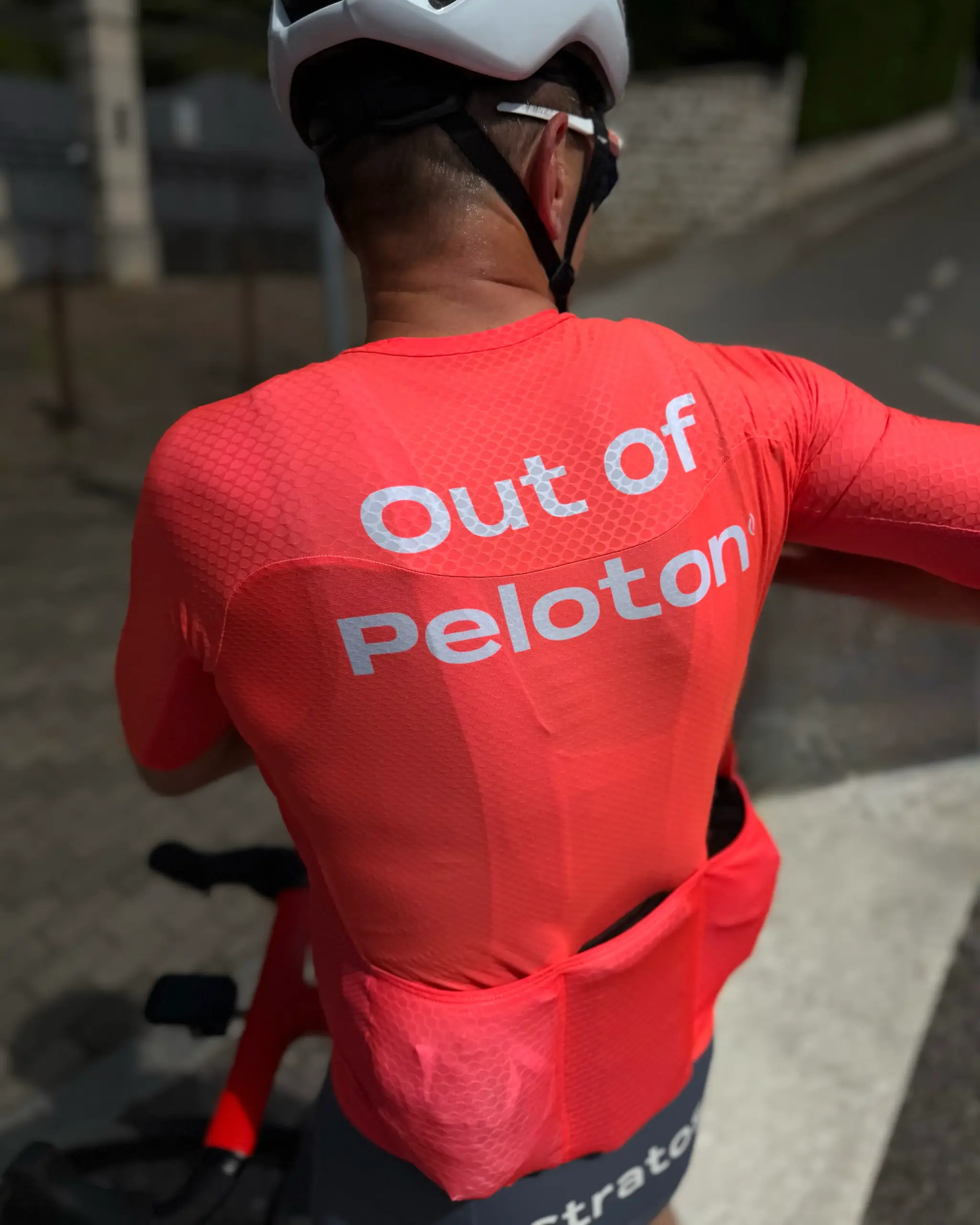
Multi-zone fabric construction responds to this. Different weights, weaves, and finishes are placed where they make sense — denser where structure is required, more open where heat dissipation matters, smoother where airflow does.
The garment behaves as a system, not as a single layer.
05Time Is the Real Test
The best way to evaluate a cycling jersey fabric is also the slowest. Use it for a month. Wash it ten times. Ride it in three weathers.
Then judge.
Cheap fabrics announce themselves quickly. They sag, they yellow, they lose elasticity, they begin to smell. Technical fabrics do the opposite — they maintain. They look the same on ride fifty as on ride one. The shoulder seam holds. The hem returns to position. The pockets keep their tension.
Performance reveals itself later. And so does quality.
A cycling jersey fabric is not what the spec sheet claims. It is what remains true after the ride is no longer easy.
Choosing With Intent
Different riding intents require different fabric strategies. The right cycling jersey fabric depends on the question being asked — distance, speed, effort, weather, frequency of use.
The Out Of Peloton® Size Guide maps each line to its intended use, and each construction to its riding context. Use it as a starting point, not as a conclusion.
The fabric becomes invisible when it matches the way you ride.
Frequently Asked Questions
Cycling Jersey Fabric — FAQ
What makes a good cycling jersey fabric?
A good cycling jersey fabric balances four functions simultaneously: thermal regulation, moisture management, dimensional stability, and surface behavior under airflow. Lightweight is not enough — what matters is how the material performs across these dimensions over hours of riding, not how it feels in the first minutes.
Is lightweight cycling jersey fabric always better?
No. Weight in isolation is a misleading indicator. A lightweight fabric without structural integrity loses its cut under effort, manages moisture poorly, and ages quickly. A heavier fabric calibrated to the riding intent can outperform a lighter generic one across every meaningful parameter.
How can I tell if a cycling jersey fabric is high quality?
First-touch hand-feel is not reliable. High-quality cycling jersey fabric reveals itself after extended use — multiple rides, multiple washes, varied conditions. A premium technical fabric holds its cut, manages moisture consistently, and maintains its appearance over time. Lower-grade materials sag, stretch out, and lose performance within weeks.